Value Investing Psychology Guide|How Emotions Shape Your Returns
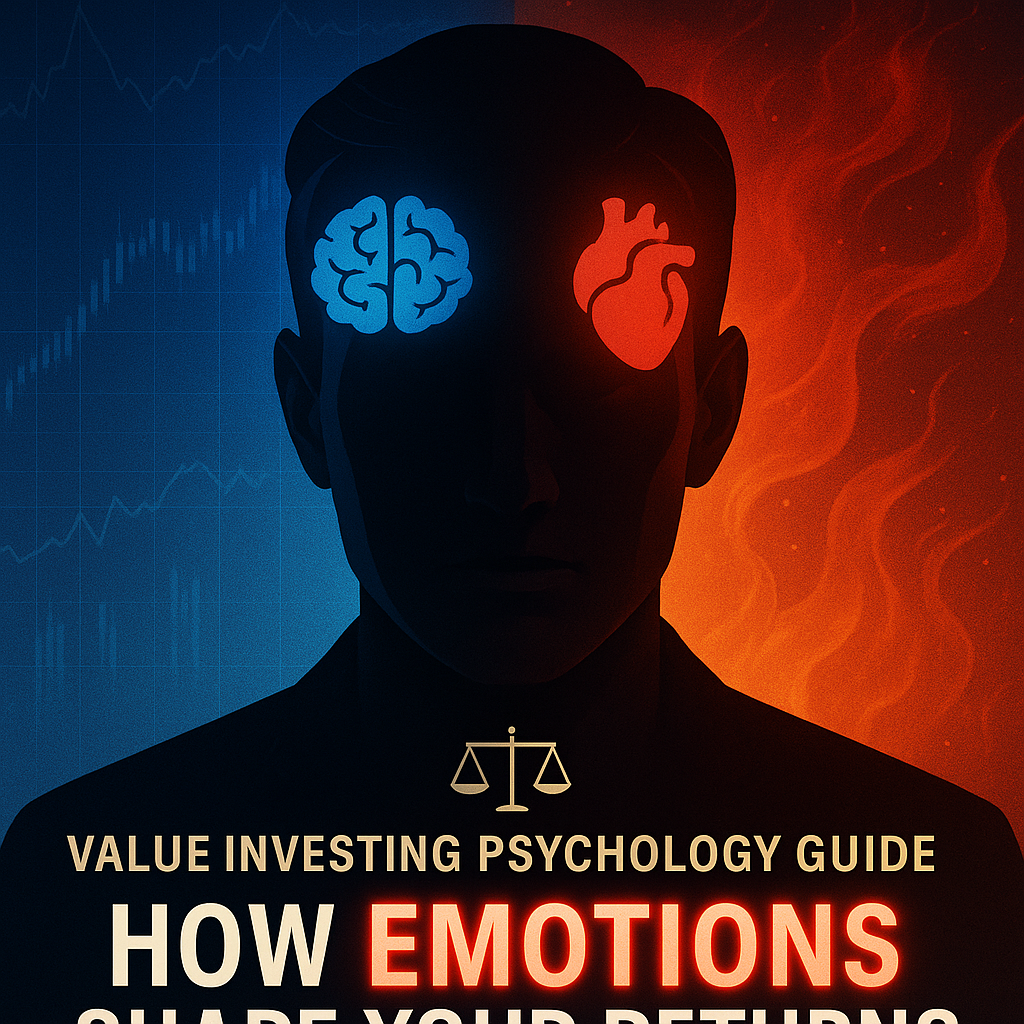
🧠 Value investing is not just about numbers—it’s about mastering your emotions.
😱 Greed and fear often destroy rational judgment and returns.
❓ Emotional discipline is the true edge of every long-term investor.
📑 Table of Contents
- 🧩 The Connection Between Psychology and Value Investing
- 💥 Greed and Fear: The Emotional Engine of Markets
- 📊 Confirmation Bias and Loss Aversion
- 🕰️ Patience and the Psychology of Long-Term Thinking
- 💡 Mental Training and Investor Routines
- 🌍 How Buffett and Marks Control Their Emotions
- 📘 Conclusion – Emotions Define Your Returns
🧩 The Connection Between Psychology and Value Investing
Value investing is not just financial analysis—it’s behavioral discipline. Success depends less on predicting market movements and more on managing one’s emotional reactions to them. Behavioral finance studies show that people interpret the same data differently depending on their emotional state. That’s why value investors must stay calm amid volatility; survival in markets depends on emotional balance, not intellectual brilliance.
💥 Greed and Fear: The Emotional Engine of Markets
Every market cycle swings between greed and fear. - Greed dominates in bull markets, pushing investors to overvalue optimism. - Fear dominates in bear markets, making them sell undervalued stocks. Warren Buffett’s famous rule—“Be fearful when others are greedy, and greedy when others are fearful”—is not just contrarian advice. It’s emotional inversion: act opposite to the crowd’s feelings, not their opinions.
| Market Condition | Emotional Reaction | Value Investor’s Move |
|---|---|---|
| Rising Prices | Greed | Compare price vs intrinsic value |
| Falling Prices | Fear | Check fundamentals before reacting |
| Sideways Market | Impatience | Focus on dividends and cash flow |
📊 Confirmation Bias and Loss Aversion
Bias is the silent enemy of investors. - **Confirmation bias:** seeking only data that supports existing beliefs. - **Loss aversion:** pain from losses feels twice as strong as joy from gains. Together, they make investors cling to bad decisions. To counter them:
1. Review three opposing opinions every month.
2. Keep a trading diary with emotions recorded.
3. Use a quantitative checklist before buying (ROE, PBR, debt ratio, cash flow).
🕰️ Patience and the Psychology of Long-Term Thinking
It can take years for intrinsic value to be reflected in the market price. During that time, frustration builds and emotions take over. Buffett says, “Time is the friend of the wonderful business.” Patience isn’t passive—it’s active emotional control. Long-term thinking means redefining time as your ally, not your enemy.
Create a calm investing rhythm:
- Check prices once a day.
- Review your portfolio monthly.
- Reassess valuation every quarter.
💡 Mental Training and Investor Routines
Emotional control is not talent—it’s a system. Professional investors develop habits that automate discipline:
| Tool | Purpose | Execution |
|---|---|---|
| Investment Journal | Emotional tracking | Record reasons and feelings at each trade |
| Split Orders | Reduce impulsive trading | Buy or sell in 3–4 steps |
| Market Fasting | Reduce noise | Disconnect from financial news monthly |
Also, maintain consistent habits—exercise, reading, rest—to sustain calm decision-making. Investing is as much physical endurance as it is analytical precision.
🌍 How Buffett and Marks Control Their Emotions
Buffett said, “In the short run, the market is a voting machine, but in the long run, it’s a weighing machine.” The message: emotions dominate in the short term, reality wins over time. Howard Marks outlined the seven emotional stages of market cycles:
1. Pessimism
2. Recovery
3. Optimism
4. Euphoria
5. Warning
6. Decline
7. Fear
Value investors buy when emotion reaches extremes—especially during “Fear.” True profits emerge when others emotionally surrender.
📘 Conclusion – Emotions Define Your Returns
The foundation of value investing is emotional steadiness. Rational analysis only matters if your emotions let you apply it. A disciplined routine builds resilience; resilience creates consistency. True investment mastery isn’t analytical brilliance—it’s emotional endurance. Markets will always fluctuate. Your mindset must not.
💬 FAQ
Q1. What happens when investors don’t control their emotions?
A. They sell too early, buy too late, and lose long-term compounding benefits.
Q2. Can emotions ever be eliminated?
A. No. But they can be observed, recorded, and neutralized through awareness.
Q3. How should I write an investment journal?
A. Include purchase reason, emotional state, and expected outcome—then review monthly.
Q4. Does value investing exclude technical analysis?
A. No. It uses it as a supporting tool, never as the core of decision-making.
Q5. How can I stay calm in a market crash?
A. Determine if the drop is due to fundamental change or temporary panic.
Q6. How do I reduce confirmation bias?
A. Read reports that disagree with your thesis—force intellectual balance.
Q7. What is the best recovery routine after losses?
A. Step away temporarily, analyze objectively, and reset your rules.
Q8. What did Buffett mean by “emotional control”?
A. Focus on what you can control—analysis—not the market’s irrationality.
Q9. Does emotional control improve with age?
A. Experience helps, but consistent routines make the real difference.
Q10. How long does it take to build stable emotional habits?
A. Usually around six months of consistent self-monitoring and journaling.
WeMakePrice Bankruptcy: Over 100 000 Sellers Affected, $400 Million Loss
WeMakePrice Bankruptcy: Over 100 000 Sellers Affected, $400 Million Loss📌 3-Line Summary🧠 The South Korean online marketplace WeMakePrice was declared bankrupt by the Seoul Bankruptcy Court on November 10 2025 due to massive unpaid settlements and re
happy0702.tistory.com
How to Avoid Value Traps in the Stock Market
How to Avoid Value Traps in the Stock Market📌 3-Second Summary🧠 A “value trap” looks cheap but stays cheap for a reason.😱 Low P/E or P/B ratios don’t always mean the stock is undervalued.❓ Here’s how to separate genuine value from a dang
happy0702.tistory.com
Assuming Discount Rate and Growth Rate in Stock Valuation
Assuming Discount Rate and Growth Rate in Stock Valuation📌 3-Line Summary🧠 The value of a stock equals the present value of its future cash flows.😱 Misjudging the discount or growth rate can severely distort intrinsic value.❓ So how should inves
happy0702.tistory.com
U.S. Loan Crisis Fear Escalates — Is Another SVB Collapse on the Horizon?
U.S. Loan Crisis Fear Escalates — Is Another SVB Collapse on the Horizon?📌 3-Line Summary🧠 U.S. regional banks are rattled as bad loans emerge, shaking confidence across the market.😱 Investors fear a repeat of the 2023 Silicon Valley Bank crisis
happy0702.tistory.com
#ValueInvestingPsychology #InvestorMindset #WarrenBuffett #HowardMarks #BehavioralFinance #LongTermInvesting #EmotionalControl #InvestmentDiscipline #StockMarketPsychology #PatiencePays #InvestmentRoutine #RationalThinking #InvestorEducation #PsychologyOfMoney #ValueInvestingGuide
'English' 카테고리의 다른 글
| Growth Stocks: Definition and Key Traits (0) | 2025.11.16 |
|---|---|
| WeMakePrice Bankruptcy: Over 100 000 Sellers Affected, $400 Million Loss (0) | 2025.11.12 |
| How to Avoid Value Traps in the Stock Market (0) | 2025.11.09 |
| Assuming Discount Rate and Growth Rate in Stock Valuation (0) | 2025.11.09 |
| U.S. Loan Crisis Fear Escalates — Is Another SVB Collapse on the Horizon? (6) | 2025.10.18 |


