WeMakePrice Bankruptcy: Over 100 000 Sellers Affected, $400 Million Loss
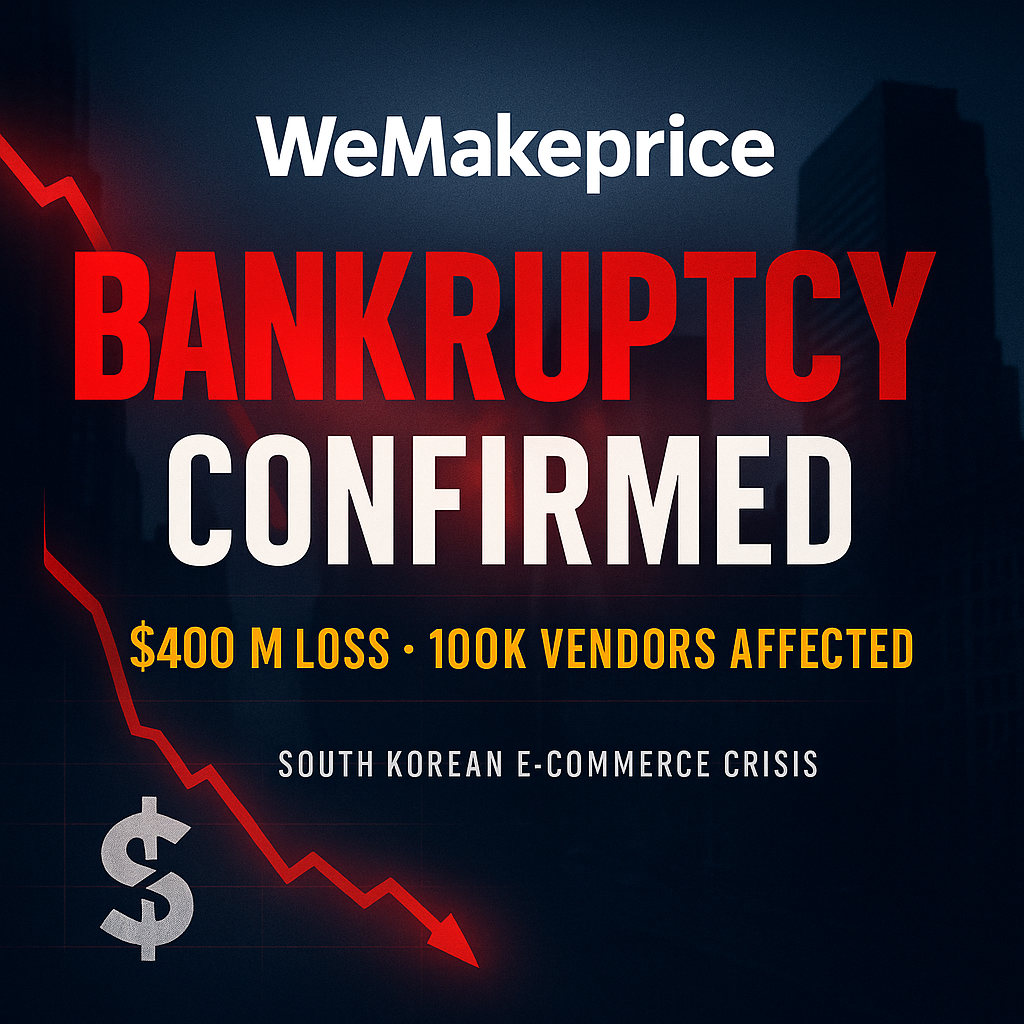
🧠 The South Korean online marketplace WeMakePrice was declared bankrupt by the Seoul Bankruptcy Court on November 10 2025 due to massive unpaid settlements and refunds.
😱 An estimated 100,000+ sellers and a loss estimated at around $400 million (≈ 600 billion won) are caught up in the fallout.
❓ What does this mean for global e-commerce platforms and how should sellers and buyers respond?
📑 Table of Contents
- ✈️ Why the warning signs were clear from the start
- 💊 Background & Timeline – How WeMakePrice spiraled into crisis
- ⚖️ Bankruptcy Details – Court decision and what it signifies
- 🛡️ Seller & Consumer Impact – What the fallout looks like
- 💡 Implications for the E-Commerce Industry
- ✅ Action Plan – What sellers and buyers should do next
- 🌍 Global Comparisons – Similar platform failures overseas
- ❓ FAQ
✈️ Why the warning signs were clear from the start
The U.S. and other mature e-commerce markets know that winning customers through aggressive discounts is only half the battle. The other half is operational reliability: timely payments to vendors, clear refund policies, and strong financial controls. In South Korea, the platform WeMakePrice once rose to prominence as a social-commerce leader. But the shifting competitive landscape and mounting internal stress pushed it toward collapse. When a platform focuses on user acquisition while sidelining the basics of vendor settlement and refund processes, it sets itself up for a potential implosion. This is exactly what happened with WeMakePrice.
💊 Background & Timeline – How WeMakePrice spiraled into crisis
| Date | Major Event | Description |
|---|---|---|
| 2010 | Launch as “WeMakePrice” | Founded as a social-commerce platform in South Korea |
| 2013 | Re-branding | Transitioned to full e-commerce platform and expanded rapidly |
| 2022 | Revenue drop | Revenue shrinking amid fierce competition (public disclosures) |
| July 2024 | Major unpaid settlements & refunds erupt | Large numbers of vendors and customers left unpaid or un-refunded |
| Nov 10 2025 | Court Declares Bankruptcy | Seoul Bankruptcy Court issues formal bankruptcy decision – liquidation ahead |
WeMakePrice’s revenue and financial position deteriorated in the face of growing vendor payout delays and refund obligations. The company attempted to secure an acquisition or merger to salvage operations but failed to secure a buyer.
⚖️ Bankruptcy Details – Court decision and what it signifies
On November 10 2025, the Seoul Bankruptcy Court (Rehabilitation Division 3) officially declared WeMakePrice bankrupt, terminating its rehabilitation process. Korea Joongang Daily According to court filings, the company’s liquidation value was significantly lower than its ongoing-business value, prompting the decision. Bankruptcy in this context means the company’s assets will be liquidated and distributed to creditors and vendors, marking the end of normal operations.
🛡️ Seller & Consumer Impact – What the fallout looks like
The number of affected vendors is estimated at over 108,000 and the damage is projected around 600 billion won (≈ US $413 million) according to media reports. However, for most vendor-creditors the likelihood of full recovery is low because unsecured vendor claims rank behind wages, taxes and other priority claims in liquidation. The broader concern for U.S. and global observers: when a platform fails to meet its payout obligations, vendors and customers alike are at risk, and consumer confidence in such marketplaces takes a hit.
💡 Implications for the E-Commerce Industry
This case underscores how marketplace-platform risk is not unique to Korea. In the U.S., brands and vendors increasingly ask: what happens if the platform goes bust? The answer: they could wake up to unpaid invoices, frozen merchant funds, or abrupt platform shutdowns. For U.S. marketplace vendors, the lesson is clear: diversification is key. One platform’s failure can ripple across your business. For platform operators, the pressure is mounting: regulatory oversight may follow, especially around vendor payouts and refund processes. Institutional investors will increasingly weigh operational risk, not just growth.
✅ Action Plan – What sellers and buyers should do next
- 📜 File Your Claims: If you’re a vendor on a platform undergoing distress, monitor bankruptcy trustee announcements and file your claims before deadlines.
- ⚖️ Assess Claim Priority: Understand that vendor invoices may be non-priority claims in liquidation scenarios.
- 🏛️ Engage Regulators / Industry Groups: Vendors should push for better protections and frameworks—especially ahead of exposure to risky platforms.
- 💡 Diversify Your Channels: Don’t rely on a single marketplace. Consider direct sales, other platforms, or hybrid models.
- 📈 Monitor Platform Health: Watch indicators like payout delays, refund complaints, and acquisition activity.
🌍 Global Comparisons – Similar platform failures overseas
While WeMakePrice is a Korea-specific case, the phenomenon of marketplace breakdowns is global. In the U.S., smaller niche platforms have folded with little warning, leaving brands and vendors scrambling. The lesson is universal: growth-at-all-costs without solid vendor support infrastructure invites systemic risk.
🔍 Conclusion
The bankruptcy of WeMakePrice offers more than a cautionary tale—it signals a structural fault line in the way e-commerce marketplaces operate. For platform operators, investors, vendors and consumers alike, the message is unmistakable: growth without reliable operations is a house of cards. For U.S. vendors and platforms observing from afar, the takeaway is clear: invest in systems, diversify exposure, and treat vendor trust as a core asset.
❓ FAQ
Q1. How do vendors file claims in a bankruptcy case like this?
A1. The appointed bankruptcy trustee issues a notice of claim filing; vendors must submit documentation before the deadline (for WeMakePrice: January 6 2026).
Q2. As a consumer who didn’t receive a refund, can I still get paid?
A2. Yes, you technically become a creditor as well—but consumer refunds often rank low in priority, meaning full repayment is unlikely.
Q3. Does this affect U.S. platforms too?
A3. Indirectly yes. When one platform fails, trust in the model drops, and vendors/consumers everywhere become more cautious.
Q4. What signals should I watch on a marketplace to assess risk?
A4. Delayed payouts to sellers, refund complaints, acquisition rumors, and sudden leadership changes are early warning signs.
Q5. Is there regulation protection for vendors in the U.S. or Korea?
A5. In Korea the regulatory framework is still catching up. In the U.S., vendor protections vary by state and platform terms—there is no centralized “vendor guarantee” system.
Q6. Can a bankrupt platform be revived through acquisition?
A6. Possibly—but only if a buyer steps in with funding and a credible restructuring plan. In the WeMakePrice case, that did not happen.
Q7. Why did the court decide liquidation was better than continuing the business?
A7. The court found that the liquidation value of the company was greater than the value of continuing operations, and no viable rehabilitation plan was submitted.
Q8. How much are the losses estimated at?
A8. About 600 billion won (~US $413 million) was reported in media as total damage impacting vendors and others.
Q9. What can vendors do to reduce platform risk going forward?
A9. Diversify sales channels, negotiate clear payout and refund terms, monitor payout timeliness, and keep reserves for disruptions.
Q10. What should consumers do if they’re using a marketplace platform?
A10. Select platforms with transparent vendor payment and refund reputations, monitor complaints, and consider buying on platforms that disclose vendor-related metrics.
Growth Stocks: Definition and Key Traits
Growth Stocks: Definition and Key Traits📌 3-Line Summary🧠 Growth stocks trade on future earnings potential, not current fundamentals.🚀 Their premium valuation reflects expectations of accelerated revenue and margin expansion.❓ This guide outline
happy0702.tistory.com
Value Investing Psychology Guide|How Emotions Shape Your Returns
Value Investing Psychology Guide|How Emotions Shape Your Returns📌 3-Line Summary🧠 Value investing is not just about numbers—it’s about mastering your emotions.😱 Greed and fear often destroy rational judgment and returns.❓ Emotional discipl
happy0702.tistory.com
How to Avoid Value Traps in the Stock Market
How to Avoid Value Traps in the Stock Market📌 3-Second Summary🧠 A “value trap” looks cheap but stays cheap for a reason.😱 Low P/E or P/B ratios don’t always mean the stock is undervalued.❓ Here’s how to separate genuine value from a dang
happy0702.tistory.com
Assuming Discount Rate and Growth Rate in Stock Valuation
Assuming Discount Rate and Growth Rate in Stock Valuation📌 3-Line Summary🧠 The value of a stock equals the present value of its future cash flows.😱 Misjudging the discount or growth rate can severely distort intrinsic value.❓ So how should inves
happy0702.tistory.com
#WeMakePriceBankruptcy #EcommerceCollapse #SouthKoreaBusiness #PlatformRisk #VendorProtection
#OnlineMarketplaceCrisis #GlobalRetailTrends #BusinessNewsNYC #ConsumerTrust #DigitalCommerce
#StartupFailure #FinancialReform #VendorClaims #LiquidationProcess #MarketplaceLessons
'English' 카테고리의 다른 글
| Buffett’s Big Move: Why Berkshire Quietly Bought $6 Billion of Alphabet (0) | 2025.11.16 |
|---|---|
| Growth Stocks: Definition and Key Traits (0) | 2025.11.16 |
| Value Investing Psychology Guide|How Emotions Shape Your Returns (0) | 2025.11.11 |
| How to Avoid Value Traps in the Stock Market (0) | 2025.11.09 |
| Assuming Discount Rate and Growth Rate in Stock Valuation (0) | 2025.11.09 |


